


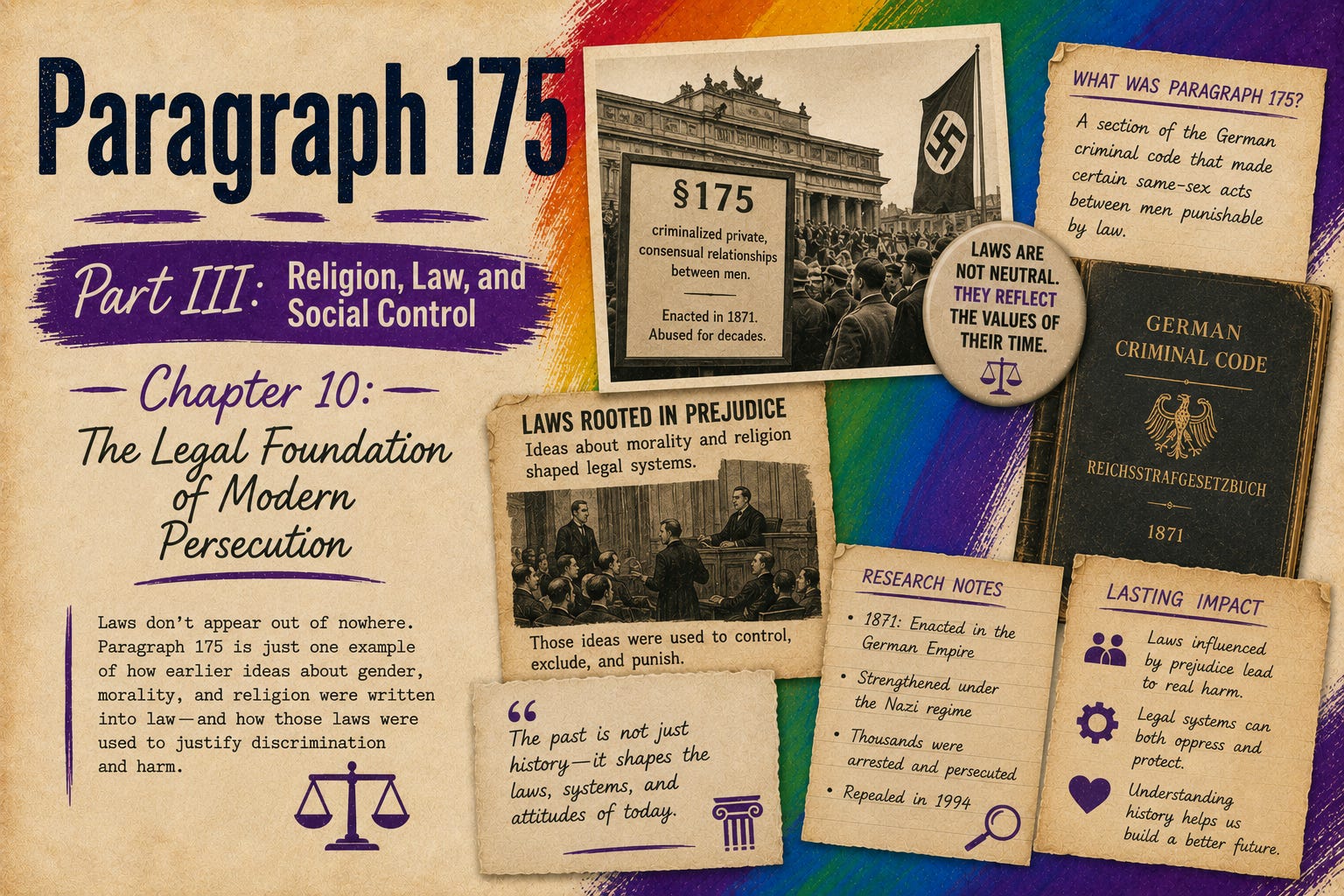
The Legal Foundation of Modern Persecution
Throughout history, societies have used laws to regulate human behavior. Some laws exist to protect people from harm. Others exist to preserve social order. Still others are designed to enforce the moral, religious, or political values of those who hold power. Among the most consequential laws in LGBTQIA+ history was a German statute known as Paragraph 175.
Although the horrors of Nazi persecution often dominate discussions of LGBTQIA+ history in twentieth-century Germany, those events did not emerge from nowhere. They were built upon legal foundations that already existed. Long before concentration camps, surveillance programs, and mass arrests, a criminal statute had established the framework through which the state could identify, monitor, prosecute, and punish men accused of same-sex relationships.
Paragraph 175 became one of the most influential anti-LGBTQIA+ laws in modern history. Its existence demonstrates how legal systems can transform social prejudice into state power and how laws often outlive the political regimes that created them.
Understanding Paragraph 175 is therefore essential not only for understanding Nazi Germany but also for understanding how legal persecution develops over time.
The Unification of Germany
Paragraph 175 entered German law in 1871 as part of the criminal code of the newly unified German Empire. Prior to unification, the German-speaking world consisted of numerous kingdoms, principalities, and states, each maintaining its own legal traditions. When political unification occurred under the leadership of Prussia, lawmakers sought to create a standardized legal system that would apply across the new empire.
The resulting criminal code included Paragraph 175, which criminalized sexual acts between men. The law reflected broader nineteenth-century concerns about morality, social order, and acceptable behavior. Although enforcement varied across regions and periods, the statute provided authorities with a legal mechanism for investigating and prosecuting individuals accused of violating its provisions.
Importantly, Paragraph 175 did not criminalize identity. The modern concept of a gay identity had not yet fully emerged. Instead, the law targeted specific acts. Nevertheless, the distinction between behavior and identity would gradually erode as governments developed more sophisticated methods for classifying and monitoring individuals.
The statute established a foundation upon which later systems of persecution could be built.
Criminalization and Social Stigma
The existence of a criminal law carries consequences beyond the courtroom. Even when enforcement is inconsistent, criminalization shapes public attitudes, influences social institutions, and reinforces stigma.
Paragraph 175 contributed to a broader social environment in which same-sex relationships were viewed as criminal, immoral, or socially dangerous. Individuals accused of violating the law faced not only legal penalties but also the possibility of public humiliation, professional consequences, family rejection, and social exclusion.
The law also influenced how authorities collected information. Police agencies, courts, and government institutions began developing records concerning individuals suspected of violating the statute. These records would later become valuable tools for future regimes seeking to expand persecution.
This pattern appears repeatedly throughout history. Laws do not simply punish behavior. They create categories, establish systems of surveillance, and shape how societies understand entire groups of people.
The Emergence of Early Activism
Ironically, the existence of Paragraph 175 also contributed to the emergence of some of the earliest organized LGBTQIA+ activism in modern history.
As scientific, medical, and social discussions concerning sexuality expanded during the late nineteenth century, some scholars and activists began challenging existing assumptions. Among the most influential figures was Magnus Hirschfeld, a physician, researcher, and advocate who would become one of the most important pioneers in LGBTQIA+ history.
Hirschfeld argued that sexual diversity was a natural part of human variation rather than a criminal or moral failing. In 1897, he founded the Scientific-Humanitarian Committee, often considered the world’s first LGBTQIA+ rights organization. One of its primary goals was the repeal of Paragraph 175.
The committee gathered signatures from intellectuals, scientists, artists, and political leaders. It published research, organized educational campaigns, and sought to challenge public misconceptions about sexuality.
Although immediate success proved elusive, these efforts marked the beginning of organized legal resistance to anti-LGBTQIA+ criminalization.
Weimar Germany: Progress and Vulnerability
The period following World War I brought significant social and political change to Germany. During the Weimar Republic, Berlin emerged as one of the most vibrant centers of LGBTQIA+ culture in the world.
Nightclubs, social organizations, publications, advocacy groups, and community spaces flourished. Researchers conducted studies concerning sexuality and gender. Public discussions became more visible. For many people, it appeared that meaningful social progress was underway.
Yet this progress existed alongside continued vulnerability.
Paragraph 175 remained law.
The statute was not repealed. Police surveillance continued. Arrests still occurred. Legal protections remained limited. The same legal framework that restricted LGBTQIA+ lives before the Weimar period remained available for future governments to exploit.
The Weimar era demonstrates an important lesson that appears repeatedly throughout history. Social visibility does not automatically produce legal security. Communities can achieve remarkable cultural progress while remaining vulnerable to political change.
The Nazi Seizure of Power
When Adolf Hitler and the Nazi Party came to power in 1933, they inherited a legal system that already contained Paragraph 175. They did not need to invent a new law from scratch. They simply expanded and intensified an existing mechanism of persecution.
The Nazi regime viewed homosexuality as incompatible with its ideological goals. Nazi leaders promoted a vision of society centered on rigid gender roles, reproduction, militarism, and racial ideology. Men accused of same-sex relationships were portrayed as threats to national strength and demographic growth.
In 1935, the regime significantly broadened Paragraph 175. The revised law expanded the range of behaviors that could trigger prosecution and made convictions easier to obtain. Activities that might previously have escaped legal scrutiny now became grounds for investigation and arrest.
The consequences were immediate and devastating.
Bureaucracy and Surveillance
One of the defining characteristics of modern persecution is bureaucracy. The Nazi campaign against homosexual men was not conducted solely through public denunciations or spontaneous acts of violence. It relied upon records, paperwork, police files, administrative procedures, and surveillance systems.
Authorities compiled lists of suspected individuals. Investigations expanded. Arrests increased dramatically. Court cases multiplied. Convictions rose sharply.
The Gestapo and criminal police used existing records, community surveillance, informants, and administrative systems to identify people targeted for prosecution. The legal foundation established decades earlier allowed the state to transform suspicion into systematic persecution.
This process demonstrates how bureaucratic systems can become instruments of oppression. Laws create categories. Institutions maintain records. Governments use those records to exercise power.
The victims often become visible to the state precisely because earlier systems documented their existence.
Imprisonment and the Pink Triangle
Thousands of men convicted under Paragraph 175 were imprisoned. Some were sent to concentration camps, where they were identified using the pink triangle badge.
Within the concentration camp system, prisoners were classified according to categories assigned by the regime. The pink triangle became the symbol associated with men imprisoned for alleged homosexual offenses.
Conditions in the camps were brutal. Prisoners faced forced labor, violence, humiliation, starvation, disease, and death. Historical estimates vary, but thousands of men were convicted under Paragraph 175 during the Nazi period, and many suffered immensely under the regime’s policies.
The pink triangle would later become one of the most powerful symbols in LGBTQIA+ history. Originally imposed as a marker of persecution, it was reclaimed by activists decades later as a symbol of remembrance, resistance, and survival.
The End of the War and the Persistence of the Law
One of the most shocking aspects of Paragraph 175’s history is that its story did not end with the defeat of Nazi Germany.
When the war ended in 1945, many concentration camp prisoners were liberated. Yet men imprisoned under Paragraph 175 often did not receive the same recognition granted to other victims of Nazi persecution. In some cases, convictions remained legally valid because the underlying law itself remained in force.
The legal system that had helped enable persecution survived the regime that used it.
Postwar Germany did not immediately repeal Paragraph 175. The law continued to affect lives for decades. Convictions continued. Stigma persisted. Many survivors remained silent about their experiences because disclosure could expose them to renewed discrimination or legal consequences.
This reality serves as a powerful reminder that the end of a political regime does not automatically erase the systems it leaves behind.
Repeal and Historical Reckoning
Efforts to challenge Paragraph 175 continued throughout the postwar period. Activists, scholars, lawyers, and community organizations pushed for reform. Gradually, legal changes reduced the scope of the statute.
West Germany partially reformed the law in 1969 and again in 1973. Complete repeal did not occur until 1994, more than a century after the statute first entered the German criminal code.
In subsequent years, Germany undertook efforts to acknowledge the harm caused by the law. Convictions were reviewed. Formal apologies were issued. Compensation programs were established for some surviving victims.
These measures could not undo decades of suffering, but they represented important steps toward historical accountability.
Why Paragraph 175 Matters
Paragraph 175 occupies a central place in LGBTQIA+ history because it illustrates how persecution develops through institutions rather than through isolated acts of prejudice alone.
The law demonstrates that criminalization is rarely a single event. It is a process. Social stigma becomes legal regulation. Legal regulation becomes surveillance. Surveillance becomes prosecution. Prosecution becomes persecution.
The history of Paragraph 175 also reveals the importance of activism. Without the efforts of people such as Magnus Hirschfeld and countless others who challenged the law over generations, its legacy might have endured even longer.
Most importantly, Paragraph 175 reminds us that rights are not guaranteed simply because social attitudes appear to be improving. Legal structures matter. Political systems matter. Historical memory matters.
The lessons of Paragraph 175 extend far beyond Germany. They provide a warning about how states can use law, bureaucracy, and ideology to target vulnerable communities.
As we move into the next section of this book, we shift our focus from legal systems to the lives of the people who lived within them. The medieval world is often portrayed as a period of silence concerning sexuality and gender, yet the historical record reveals a far more complex reality.